Blog Post 2 – EDCI 338
Building a PLN and Digital Identity Online
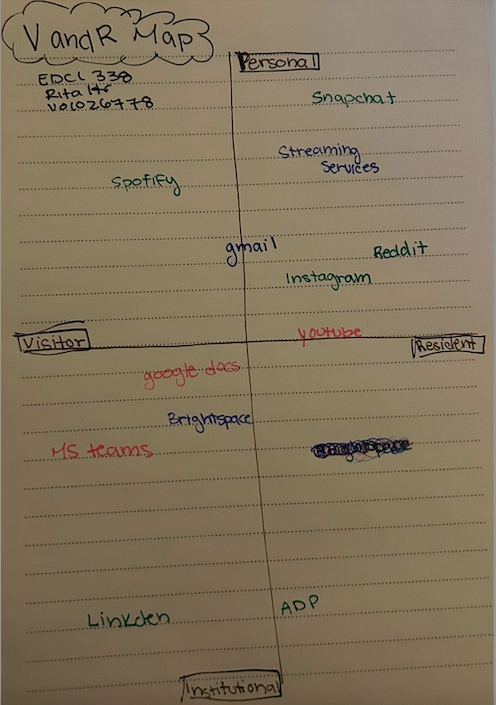
My Visitor and Resident Map
After creating my Visitor and Resident map, I realized I use a lot more digital platforms than I originally thought. Platforms like Brightspace, Google Docs, MS Teams, and LinkedIn fit more into my “visitor” category because I mostly use them for school, assignments, or communication. I usually log onto these apps with a specific purpose rather than casually browsing. Apps like Instagram, TikTok, Reddit, Instagram, and YouTube are much more personal for me. These are the platforms I spend the most time on outside of school. I use them for entertainment, hobbies, current events, and interacting with friends. Before making my map, I never really thought about how even apps I use casually still shape how people might see me online. White and Le Cornu (2017) explain that digital spaces are not simply divided into personal or professional use, but instead reflect different ways people engage and participate online.
Expanding My Professional Learning Network
One thing I noticed while making my map is that I mostly observe professional spaces rather than actively contribute to them. For example, I use LinkedIn mainly to browse opportunities, keep up with connections, or see what others are doing professionally. I rarely post anything myself. I think one way I could expand my PLN would be by becoming more active online professionally. Following people in careers I am interested in, joining discussions, and sharing projects or experiences could help build more connections over time. Right now, I think I mostly use social media to consume information rather than contribute to conversations.
Privacy, Digital Identity, and Employers
The privacy and surveillance readings made me think more critically about how much information social media platforms actually collect. Most people know apps track data, but I do not think many people fully understand how permanent digital footprints can become. Regan and Jesse (2019) discussed how privacy concerns become more complicated in digital learning environments because platforms constantly collect user data and online activity.
This assignment also made me think about what an employer would see if they searched my name online. I would want them to see someone professional and responsible, but also authentic. It feels strange knowing that something posted casually could still be seen by employers or professors years later. I think this creates pressure to balance personality with professionalism online. At the same time, employers also have expectations around online behaviour and communication. Even if there are no official policies, people are still judged based on what they post publicly. Research has also connected social media use to increased anxiety around self-image and online self-presentation, especially among younger users (Regan & Jesse, 2019). I think this pressure causes many people to carefully manage what they post online, even on platforms that are supposed to feel casual.
Inclusion and Diversity in My PLN
Something else I reflected on this week was how diverse my PLN actually is. Social media gives people opportunities to hear perspectives and experiences they would probably never encounter otherwise. Following people from different backgrounds, cultures, and careers can really expand understanding and challenge assumptions. I think one of the biggest learning outcomes of a diverse PLN is developing a better understanding of experiences outside your own. Social media can expose people to new viewpoints very quickly, but it also depends on who you choose to follow and interact with. Moore and Schnellert (2017) discuss how inclusion is not a single fixed approach and instead depends on recognizing and supporting different needs and experiences. I try to make sure my PLN includes a variety of voices rather than only people with similar opinions or experiences to mine.
At the same time, I think social media algorithms can sometimes limit diversity because they often recommend content similar to what users already interact with. Because of this, I think creating a diverse PLN takes intentional effort. If people only follow voices they already agree with, social media can easily become an echo chamber instead of a place for learning. A strong PLN should not only allow people to share their own views, but also amplify and support the perspectives of others.
References
Moore, S., & Schnellert, L. (2017). One without the other: Stories of unity through diversity and inclusion. Portage & Main Press.
Regan, P., & Jesse, J. (2019). Ethical challenges of edtech, big data and personalized learning: Twenty-first century student sorting and tracking. Ethics and Information Technology, 21(3), 167–179.
White, D. S., & Le Cornu, A. (2017). Using visitors and residents to visualize digital practices. First Monday, 22(9).https://firstmonday.org/ojs/index.php/fm/article/view/7802/6515